
Structure造り
Traditional Japanese Knives (Wa-bocho)

There are two principal construction methods for Japanese knives:
Single-Steel Construction (Ichimai-gane)
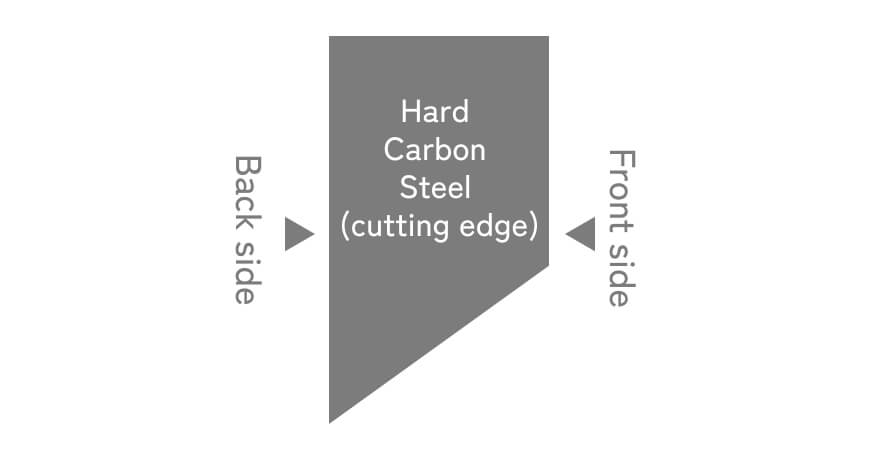

Made from a single piece of hard carbon steel.
Two-Layer Construction (Nimai-gane / Awase)
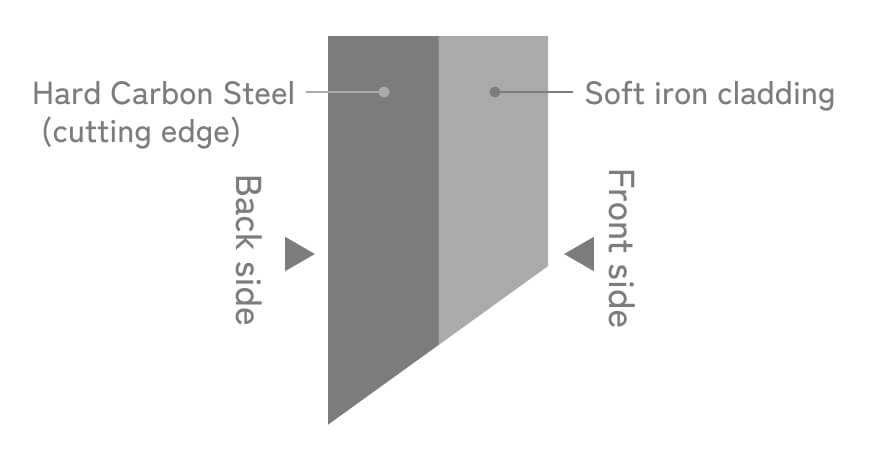
Made by combining two layers: hard carbon steel as the edge and soft carbon steel as the cladding.
Honyaki (Single Steel)
Honyaki knives are forged entirely from a single piece of high-carbon steel and hardened without any cladding . Unlike layered constructions, there is no soft iron on the outsideon the outsi — the blade’s performance depends solely on the quality of the steel and the precision of heat treatment.
Characteristics:
- Maximizes inherent hardness
By eliminating softer cladding, Honyaki construction allows the steel to reach its full martensitic hardness potential. This results in superior edge retention. - Increased brittleness
Without a softer supporting layer, the blade becomes more susceptible to chipping or cracking if misused. Proper technique and careful handling are essential. - Exceptional cutting performance
The uniform steel structure enables an extremely refined edge, producing outstanding sharpness and smooth unpareralled cutting feel.
※Because engraving must be completed prior to the hardening process, custom name engraving requires a special made-to-order request.
Hon-Kasumi (Two-Layer Construction / Awase)
Hon-Kasumi knives are constructed by forge-welding a hard high-carbon steel cutting core (hagane) to a softer base iron (jigane). This structure concentrates hardness at the edge while maintaining structural flexibility through the supporting iron layer. It represents the most widely adopted forging method in traditional Japanese professional kitchen knives, offering a refined balance between sharpness, durability, and ease of maintenance.
Characteristics:
- Hard Steel Core (Hagane)
The cutting edge is made from hardened high-carbon steel, enabling excellent sharpness and strong edge retention. - Softer Base Iron (Jigane)
The backing iron provides shock absorption and structural support, reducing brittleness and making the blade more resistant to cracking.
This construction balances performance with usability and is widely adopted.
Nami-Kasumi (Two-Layer Construction / Awase)
Nami-Kasumi knives feature a laminated two-layer construction, combining a hardened cutting core with a softer supporting base. While structurally similar to Hon-Kasumi, the manufacturing emphasis differs. Where Hon-Kasumi prioritizes traditional balance between sharpness and resilience, Nami-Kasumi is engineered with greater focus on edge retention and practical durability. Heat treatment and material selection are optimized to maintain sharpness during repetitive, high-volume use.
Characteristics:
- Engineered for extended edge longevity, maintaining sharpness through sustained, repetitive use.
- Optimized for market and processing environments, delivering reliable performance in high-volume, and demanding conditions.
- First Choice for home use, offering professional-grade durability with practical manageability.
Suminagashi / Layered Construction
Suminagashi knives are constructed by forge-layering multiple sheets of differing steels, creating a layered structure that enhances structural stability and aesthetic depth. While the core steel determines cutting performance, the cladding contributes to durability and visual distinction.
Characteristics:
- Enhanced structural durability through multi-layer lamination, improving resistance to stress and deformation.
- Distinctive flowing surface patterns, formed naturally from the layered steel during forging and polishing.
- Balanced performance and aesthetics, combining functional strength with refined craftsmanship.
Kurouchi (Two-Layer Construction / Awase)
Kurouchi knives are constructed with a hardened cutting core supported by softer cladding layers, manufactured with emphasis on toughness and sustained edge retention. The structure prioritizes durability and dependable performance in demanding environments.
Characteristics:
- Strong and durable construction, reinforced by supportive cladding layers that enhance structural resilience.
- Unpolished forged surface (dark finish), retaining the natural oxide scale formed during heat treatment.
- Reduced sticking, as the textured surface helps minimize adhesion of oils and fats during cutting.
- Highly practical for markets, processing facilities, and home kitchens, offering reliable performance with manageable maintenance.
Characteristics:
- Seamless all-metal construction, providing superior structural stability and long-term durability.
- Heat-resistant and sterilizable, capable of withstanding boiling water and rigorous sanitation protocols.
- Exceptional hygiene control, as the unified design eliminates gaps where moisture, bacteria, or debris could accumulate.
- Ideal for professional and institutional environments, particularly where strict cleanliness standards are required.
Western-Style Knives (Yo-bocho)

Single-Steel Construction (Solid Steel)
Single-steel knives are forged entirely from one continuous type of steel, without cladding or layered construction. The blade’s performance characteristics are determined solely by the selected steel and its heat treatment.
Characteristics:
- Uniform steel composition throughout, providing consistent properties from edge to spine.
- Direct transmission of cutting feel, as there is no softer supporting layer to alter feedback.
- Typically double-bevel construction, though the edge geometry can be adjusted or biased toward a single-bevel profile when desired.
- Simplified maintenance, as the blade consists of a single material without layered boundaries.
Three-Layer Steel / Warikomi
Three-layer construction consists of a hardened core steel positioned between two outer layers of softer steel, forming a protective and supportive structure. This method is commonly referred to as Warikomi, meaning “inserted steel,” as the hard core is embedded within the surrounding material. In Warikomi construction, the core steel provides cutting performance and edge retention, while the outer layers enhance toughness, absorb shock, and improve overall structural stability.
Characteristics:
- Hardened core steel engineered for maximum sharpness and sustained edge retention, ensuring precise and efficient cutting performance.
- Supportive outer layers designed to enhance structural integrity and absorb mechanical stress, improving resistance to impact and deformation.
- Optimized balance between cutting efficiency and mechanical durability, achieved through strategic distribution of material properties.
※ Edge sharpening is limited to double-bevel configuration.
Tsuchime (Hammered Finish)
Tsuchime is a forged surface finish created through controlled hammering, producing a patterned series of indentations across the blade. This texturing reduces surface contact during cutting to improve ingredient release, while simultaneously imparting a distinctive handcrafted aesthetic.
Characteristics:
- Textured surface promotes improved food release, as air pockets reduce surface contact during cutting.
- Minimizes sticking, particularly when slicing moist or starchy ingredients.
- Functional surface treatment, without altering the core structural composition of the blade.
Damascus
Damascus construction is achieved by repeatedly layering and forging different steels together, producing a multi-layered structure. While the core steel determines cutting performance, the layered cladding enhances structural stability and creates distinctive visual patterns.
Characteristics:
- Enhanced structural durability through multi-layer steel composition.
- Distinctive flowing surface patterns, naturally formed from the layered steels during forging and polishing.
- Combination of performance and refined craftsmanship aesthetics.